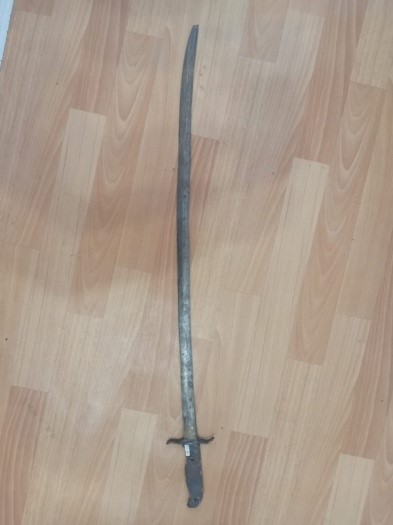


This antique blade (saber/sword) dates back to the 18th century; its active use during the 1916 National Liberation Uprising in Torgay—led by Amangeldy Imanov and Abdigapar Khan—is a historically documented fact.
During the 1916 Torgay Uprising, the insurgents (*sarbaz*) faced a severe shortage of modern firearms. Consequently, the martial heritage of their ancestors was once again brought into service on the battlefield.
Description of the artifact within the context of the 1916 events:
- The role of local smithies: Blacksmiths across the Torgay steppes worked urgently to restore such antique blades—resharpening the edges, reinforcing the hilts, and refitting the grips to meet the needs of the fighters.
- Historical continuity: Labeled as "Weapon of the Kazakh Warriors," this artifact bridges two significant eras in the Kazakh people’s struggle for independence: the 18th-century resistance against the Dzungars and the liberation movement of 1916.
This artifact is an authentic combat weapon—a saber crafted by Torgay artisans and wielded by *sarbaz* during the 1916 National Liberation Uprising in Torgay. This valuable piece was discovered in the village of Kalam-Karasu. The saber serves as a vital historical monument, preserving the memory of the courage of anonymous steppe craftsmen and the heroism of the Torgay *sarbaz* in their fight for freedom.