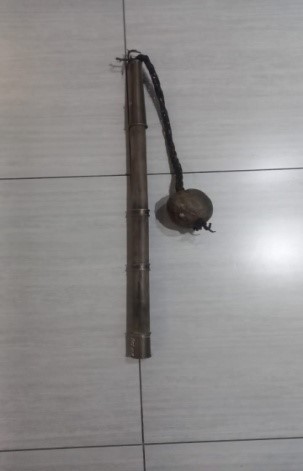


The *shokpar* (war club/mace) is one of the five traditional weapons (*bes qaru*) used by nomadic Turkic peoples—including Kazakh *batyrs* (warriors)—for close-quarters combat. It was designed to shatter an enemy’s shields, helmets, and armor, as well as to stun opponents or knock them from their saddles.
The *bosmoyyn shokpar* (a type of flail-mace with a flexible attachment) is a highly maneuverable weapon; its striking force and destructive power significantly exceed those of a standard, rigid club. This exhibit consists of two main components:
- Shaft (Handle): Hewn from durable wood (such as spiraea, maple, or birch) and reinforced with metal rings (bands). A sturdy, braided leather strap (or chain) is securely attached to the upper end of the shaft. 2. Head (Striking Part): A heavy, spherical metal head (cast from iron or copper, or filled with lead), suspended from a flexible leather strap.
Usage and Functionality:
During duels (*zhekpe-zhek*) and close-quarters combat, the heavy, free-swinging head would gain high velocity through inertia when swung and thrust forward, enabling it to crush an opponent’s shields, helmets, and iron armor. This weapon was highly effective for delivering sudden, forceful blows during mounted combat. A leather loop (*temlyak*/*büldirgi*) is attached to the end of the handle, allowing it to be secured around the wrist and preventing the weapon from slipping out of the user's grip. *Shokpar* (maces) were used by *batyrs* (warriors) not only in military campaigns; herders and horse wranglers also frequently employed them for protection against *barymta* (livestock raiding) and for hunting.
Note:
This item is not an authentic artifact dating back to the 18th century. It is a historical reconstruction, crafted based on traditional designs in 1993 specifically for a museum exhibition commemorating the 300th anniversary of the birth of Shakshak Zhanibek Batyr.